
The complex, challenging market and economic environment continues heading into the third month of the year. With several indicators flashing recession, investors would do well to consider short duration, actively managed bond strategies.
The recent inversion of the Fed-preferred 10-year and 3-month Treasury yield curve and the Federal Reserve Bank of Atlanta’s GDPNow update to -1.5 for the first quarter’s GDP estimate both signal recession concerns. While not foolproof indicators of impending recession, the combination of the two merits advisor and investor attention.
The 10-year and 3-month Treasury yield curve inversion does not always portend impending recession, such as its inversion in 2022. However, it’s proceeded economic downturns often enough that the Fed closely monitors the indicator. The yield curve inverted once again on Wednesday, February 26, reflecting a risk-off mentality from investors.
Meanwhile, the FRED GDPNow model downgraded GDP growth estimates for Q1 from 2.3% growth two weeks ago to -1.5% growth as of the final day in February. The model uses inputs that mirror the methodologies used by the U.S. Bureau of Economic Analysis. These include trade inputs and consumer spending.
The trade deficit ballooned in January to a record $153.3 billion on soaring imports, reported Reuters. This could be attributed to companies attempting to front-run potential tariffs by building up supply. At the same time, U.S. consumers curtailed spending by the largest month-over-month decline since February 2021, reported CNN.
Invest for Recession, Inflation, or Rate Risk With NBSD
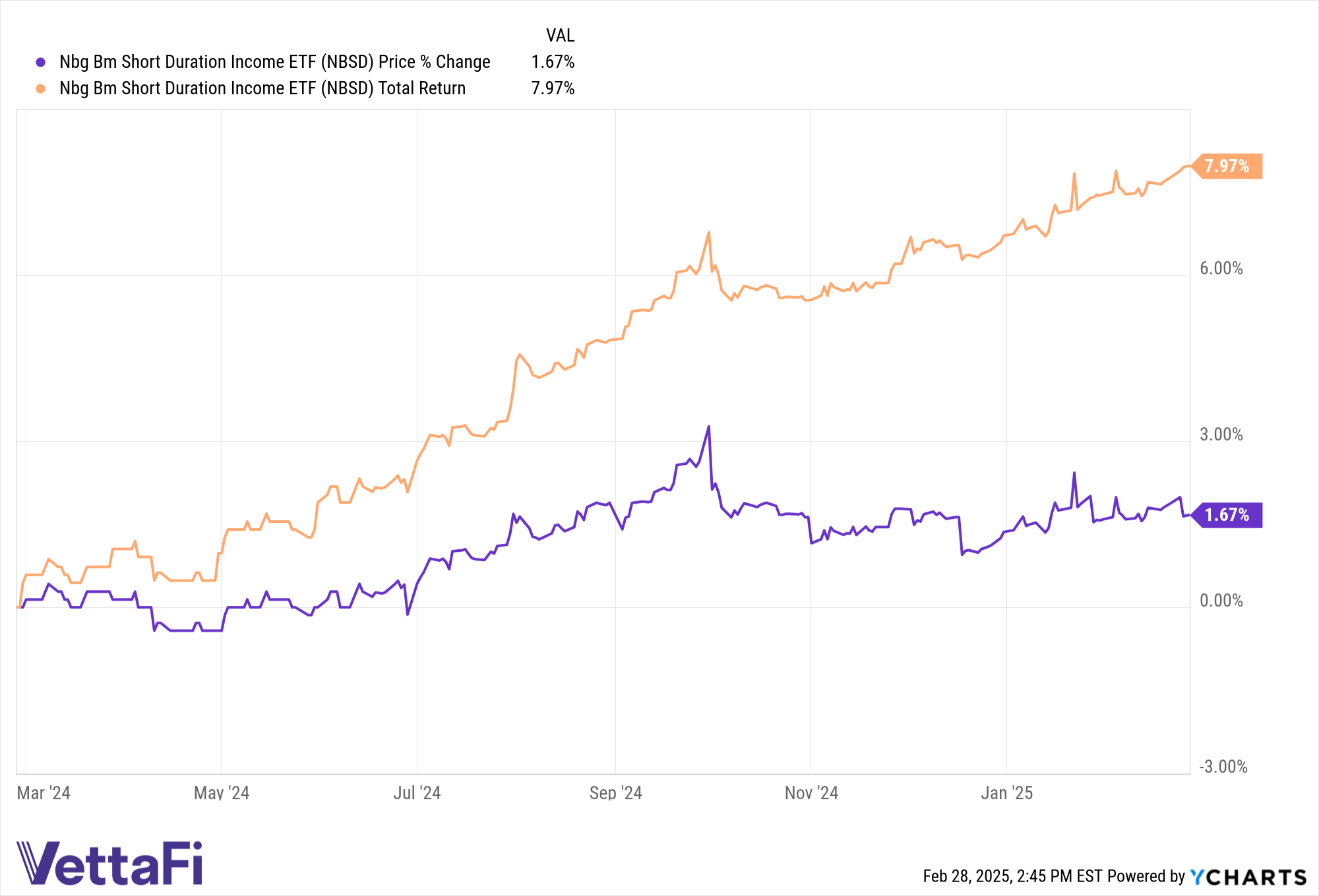
Advisors and investors looking to reduce their inflation and rate risk would do well to consider the Neuberger Berman Short Duration Income ETF (NBSD). The actively managed fund seeks to generate reliable income while providing an investment-grade, short-duration profile for portfolios. Short-term bonds often prove appealing for their reliable income potential when interest rate, inflation, or recession risks spike.
See also: ETF of the Week: Neuberger Berman Short Duration Income ETF (NBSD)
The fund invests across a variety of sectors and bond types, including fixed- and floating-rate investment-grade bonds, both foreign and domestic. These can include asset- and mortgage-backed securities, collateralized debt obligations (including CLOs), and credit risk transfer securities.
The management team considers both qualitative and quantitative factors when selecting securities. They search for underpriced bonds, both on a sector level as well as within peer groups. While 80% of the fund is comprised of investment-grade bonds, up to 20% may be below investment-grade. When investing in these junk bonds, the fund managers seek issuers in relatively strong financial health and whose credit scores may increase.
The strategy also works to reduce credit risk through its diversified exposures. NBSD currently offers a 30-day SEC yield of 5.49%, as of January 31, 2024. NBSD also offers a distribution rate of 5.71% over the same period. Distribution rate annualizes the most recent distribution and then divides by the most recent NAV. The weighted average duration of the fund was 1.88 years as of December 31, 2024.
NBSD carries an expense ratio of 0.35%.
For more news, information, and analysis, visit the Invest Beyond Cash Channel.
